
Ol Roy Dog Food Review: Is It Worth The Cheap Price?
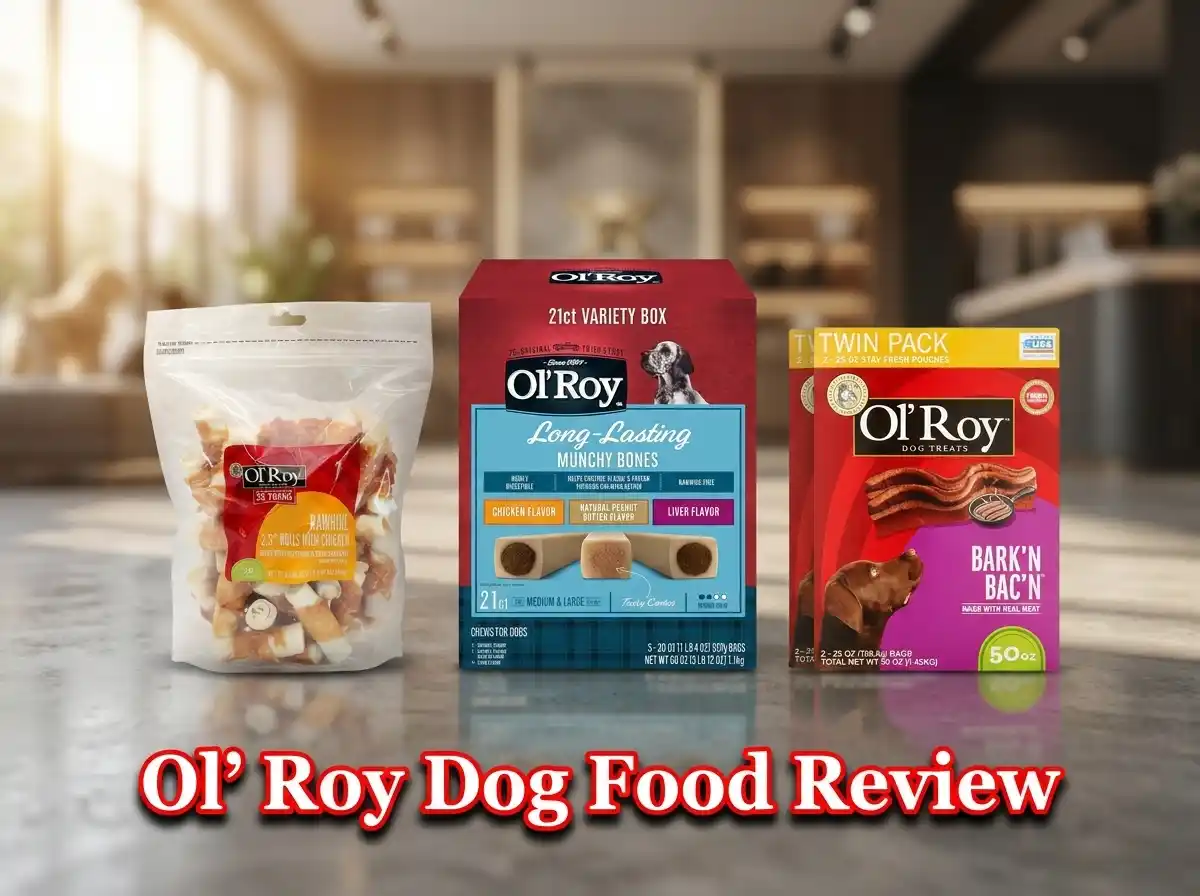
Buying dog food on a tight budget can be hard. You need food your dog will eat, a recipe that meets its needs, and a price you can manage every month. Ol’ Roy is a familiar Walmart brand with dry kibble, puppy food, and wet meals. But a low price and a happy dog do not tell the whole story. This Ol Roy Dog Food Review looks at the main recipes, ingredients, nutrient estimates, customer feedback, and past recalls to help you make a sound choice.
Key Takeaways
Best feature: Ol’ Roy offers a wide range of low-cost dog food options.
Main concern: Several dry recipes rely on corn, plant protein, and meat and bone meal.
Best place to start: Compare the adult Chicken and Rice recipe with the High Protein Red Meat formula.
For puppies: Choose a recipe labeled for growth, not one intended only for adult maintenance.
Safety matters: Ol’ Roy has a documented recall history involving specific products and batches.
Overall verdict: A budget option worth careful label checks, but not my first choice when ingredient detail and nutritional transparency are top priorities.

Ol Roy Dog Food Review: Quick Verdict
Quick Verdict: Ol’ Roy may suit healthy adult dogs in homes where food costs are a major concern. Its broad range of recipes, large bags, and low prices are appealing, but its ingredient choices and past recalls deserve a close look.
| Evaluation factor | Product details | Practical assessment |
|---|---|---|
| Primary target | Adult dogs, puppies, and dogs needing dry or wet food | Several options for different life stages |
| Core ingredients | Corn, meat and bone meal, soybean meal, poultry ingredients, and added nutrients in selected dry recipes | A value-focused formula with mixed protein sources |
| Nutrition | Walmart lists 20 g of protein per 8-ounce cup for its standard dry formula | A useful starting figure, but not enough to judge total diet quality |
| Safety and compliance | Product labels provide nutritional adequacy information; historical recalls affected selected products | Review the exact recipe and any current recall notice before buying |
Is Ol Roy Dog Food Good?
Ol’ Roy can be a practical choice for some healthy adult dogs, but I would not rank it among the strongest options for ingredient transparency. Its main selling point is affordability, rather than a formula built around clearly named animal proteins.
Who should consider it: Owners who need an affordable complete food for healthy adult dogs and can monitor weight, digestion, and body condition.
Who should look elsewhere: Owners of dogs with confirmed food allergies, ongoing digestive problems, or medical needs that call for a veterinary diet.
The main distinction is between a food that meets basic nutrient needs and one that best fits a particular dog. A product can be complete and balanced without being the ideal choice for every pet.
Ol’ Roy’s low price may help a household feed several dogs without stretching its budget. Still, the right decision depends on each dog’s age, health, activity, and response to the recipe.
A useful way to judge the brand is to look past the flavor name on the bag. Compare the nutritional adequacy statement, protein sources, calorie content, and feeding cost.

Pros and Cons of Ol’ Roy
Ol’ Roy has real practical strengths, but its low price comes with trade-offs in ingredient selection and the detail available to shoppers.
| Type | Feature | Practical assessment |
|---|---|---|
| Pro | Low cost | Large bags can help lower the daily feeding bill. |
| Pro | Multiple recipe types | Dry, wet, puppy, and small-bite options serve different needs. |
| Pro | Familiar flavors | Chicken and rice, beef-style flavors, and gravy meals give owners choices. |
| Pro | Broad retail access | Walmart listings make the range easy to find in many areas. |
| Pro | Added vitamins and minerals | These can help a formula meet its nutrient targets. |
| Con | Heavy use of grains in some recipes | Corn and other grains supply energy but do not make a recipe high in animal protein. |
| Con | Broadly named animal ingredients | Terms such as meat and bone meal give less detail than a named meat source. |
| Con | Different formulas have different targets | An adult recipe is not a substitute for a puppy growth formula. |
| Con | Past safety recalls | Older incidents make checking the exact product and batch important. |
| Con | Limited calorie detail on some listings | Without calories per cup, portion planning is harder. |
Recipe and Label Analysis
Ol’ Roy is a product family, not a single formula. Its dry food, puppy recipes, and wet meals can differ in their protein sources, texture, nutrient targets, and intended life stage.
Retail listings show several of the following options. Availability, package sizes, and exact ingredient statements can vary by product listing and market.
Ol’ Roy Recipe Comparison
The scores below are editorial ratings of the recipe’s position within a budget food range. They are not clinical test results or claims about health outcomes in individual dogs.
| Recipe variant | Rating / 5 | AAFCO profile code* | Main protein or ingredient | Target dog |
|---|---|---|---|---|
| Complete Nutrition Chicken and Rice Dry | 2.5 | M | Meat and bone meal, soybean meal, chicken by-product meal | Adult dogs |
| Complete Nutrition T-Bone and Bacon Dry | 2.5 | M | Meat-based meal and grain ingredients | Adult dogs |
| Complete Nutrition Small Bites | 2.5 | M | Chicken and rice flavor; grain-based kibble | Small dogs or dogs that prefer smaller pieces |
| High Protein with Red Meat Dry | 2.75 | M | Meat and bone meal, corn protein meal, lamb meal | Adult dogs of various sizes |
| Puppy Complete Chicken and Oatmeal Dry | 2.5 | G | Chicken meal, oat ingredients, fish oil | Growing puppies |
| Puppy Complete Chicken Dry | 2.5 | G | Chicken-based ingredients and added nutrients | Growing puppies |
| Chicken and Rice Dinner Wet Food | 2.5 | A** | Chicken and rice flavor with moisture-rich ingredients | Dogs covered by the current package’s life-stage statement |
| Cuts in Gravy Wet Food | 2.5 | A** | Meat-based ingredients in gravy | Dogs covered by the current package’s life-stage statement |
| Meaty Loaf Wet Food | 2.25 | A** | Meat-based ingredients in a soft loaf | Dogs covered by the current package’s life-stage statement |
\* G means growth, M means adult maintenance, and A means all life stages. These are shorthand codes for comparison; the nutritional adequacy statement on the exact product package takes precedence.
\** Retail listings have grouped some wet products under all life stages. Confirm the intended life stage for the specific recipe before feeding it to a puppy or breeding dog.
Which Recipe Is the Best Starting Point?
Complete Nutrition Chicken and Rice is the most straightforward starting point for an adult dog. It offers a familiar flavor and a low-cost dry format, but the ingredient list includes several grain and plant-protein sources.
High Protein with Red Meat has a different nutrient positioning. Its ingredient list includes meat and bone meal, corn, wheat, rice bran, corn protein meal, chicken fat, beet pulp, and lamb meal. The name alone does not prove that most of its protein comes from named red meat.
Puppy Complete deserves its own category because growing dogs need different nutrient levels and ratios from adult dogs. Do not choose an adult-maintenance formula simply because a puppy likes its flavor.
For owners weighing other price points, a Purina One Dog Food Review can provide a useful comparison point. The goal is to compare complete formulas, not just compare the cost of two bags.
Guaranteed Analysis
The guaranteed analysis shows the minimum or maximum amounts of certain nutrients in a pet food. It is useful, but it does not reveal every detail needed to assess overall food quality.
Walmart’s current product information for standard Ol’ Roy Complete Nutrition Dry Dog Food states that an 8-ounce cup provides 20 grams of protein. That is a listed serving figure, not a full picture of the recipe’s amino acid balance or calorie density.
For an informed comparison, look for these values on the exact package:
| Nutrient or detail | What it tells you | Why it matters |
|---|---|---|
| Crude protein | Minimum protein content | Helps compare formulas, but does not reveal the quality of every protein source |
| Crude fat | Minimum fat content | Fat supplies energy and essential fatty acids |
| Crude fiber | Maximum fiber content | Helps describe the food’s fiber level |
| Moisture | Maximum water content | Allows a fairer comparison of dry and wet food |
| Calories | Energy per cup, can, or kilogram | Helps determine how much to feed and compare cost per day |
| Nutritional adequacy statement | Intended life stage and feeding purpose | Helps distinguish a complete diet from a food intended only for supplemental feeding |
The AAFCO guide to reading pet food labels explains why the nutritional adequacy statement matters. It also explains how ingredient names and product names are regulated.
Dry-Matter Nutrient Analysis
Dry-matter analysis removes moisture from the comparison. This helps make dry kibble and wet food more comparable.
One published analysis of Ol’ Roy Complete Nutrition Adult estimated the following dry-matter nutrient levels:
| Metric | Estimated value |
|---|---|
| Protein | 24.5% |
| Fat | 12.0% |
| Carbohydrates | 50.8% |
| Fat-to-protein ratio | About 49% |
These estimates are useful for understanding the broad nutrient profile, but they should not be treated as guaranteed values for every Ol’ Roy recipe. A different product or revised formula may produce different numbers.
The fat-to-protein ratio is also not a quality score. A ratio near 49% simply means that the estimated fat percentage is about half the protein percentage. It does not show whether a dog will digest the food well or maintain a healthy weight on it.
A reliable calorie-weighted breakdown requires the calorie content of the exact formula. Where that figure is not provided in the available product listing, it is not sound to invent a number or assume all Ol’ Roy recipes have the same caloric density.

Ingredients Analysis
The ingredient list helps explain where the food’s nutrients come from, but each ingredient needs to be judged by its role and context. Corn is not automatically harmful, and a meat meal is not automatically poor quality; the real question is how the complete formula is made and whether it suits the dog.
The following analysis focuses on ingredients listed for Ol’ Roy’s standard Chicken and Rice and High Protein with Red Meat dry formulas.
1. Ground Whole Grain Corn
Corn provides starch for energy and contributes some protein and other nutrients. It can serve a useful role in a complete diet.
The trade-off is that a recipe led by corn may rely heavily on grains for its energy and part of its protein supply. Dogs that need a particular diet for a medical reason may need a different formula.
2. Meat and Bone Meal
Meat and bone meal provides protein, minerals, and other nutrients from rendered animal materials. Its nutrient value can vary with the raw materials and processing.
The term does not tell shoppers which animal species supplied the meal. That makes it less specific than a clearly named protein source, especially for a dog with a confirmed ingredient sensitivity.
3. Soybean Meal
Soybean meal is a concentrated plant-protein ingredient. It can help raise the recipe’s crude protein figure and supply amino acids.
The important question is not whether plant protein exists in the formula. It is whether the complete diet provides the essential amino acids in suitable amounts and ratios.
4. Animal Fat
Animal fat adds energy and helps make kibble appealing. Fat also helps deliver essential fatty acids.
The broad ingredient name gives less detail about the animal source. That is a transparency trade-off rather than proof that the ingredient is unsafe.
5. Corn Gluten Meal
Corn gluten meal is a concentrated source of corn protein. It can raise the overall protein figure without relying entirely on animal-derived protein.
Crude protein totals do not reveal exactly how much protein comes from each source. Owners comparing products should look at the full ingredient list alongside the guaranteed analysis.
6. Chicken By-Product Meal
Chicken by-product meal can include nutrient-rich animal tissues such as organs. These materials are not inherently inferior simply because they are by-products.
Its main drawback for shoppers is that it gives less detail than a recipe built around clearly named meat cuts. Ingredient names alone cannot establish the digestibility or final nutritional value of a complete formula.
7. Brewer’s Rice
Brewer’s rice is a processed rice ingredient used to provide carbohydrates. It is not a special source of meat protein, but it can supply usable energy.
Its inclusion is not enough to judge a formula as good or bad. What matters is the balance of all ingredients and the dog’s dietary needs.
8. Natural Flavor and Salt
Flavor ingredients can help improve palatability, while salt contributes sodium and chloride. Potassium chloride can supply potassium.
These ingredients have functional roles. Still, an ingredient list does not tell you whether a food is suitable for a dog that needs a specific sodium or mineral target.
9. Beet Pulp
The High Protein with Red Meat recipe lists dried plain beet pulp. This ingredient supplies fiber and may help support normal stool quality.
Beet pulp is sometimes dismissed as filler, but that view is too simple. Fiber can serve a useful purpose; the effect depends on the whole diet and the individual dog.
10. Vitamins and Minerals
Ol’ Roy formulas include added vitamins and minerals to help meet nutrient targets. The red meat recipe lists ingredients such as zinc sulfate, iron sulfate, copper sulfate, manganese sulfate, and sodium selenite.
Mineral forms differ in their chemical properties and how they are used in the body. Their presence alone does not prove a food is excellent or poor, and an ingredient list does not establish the precise absorption of each mineral.
Ingredient Controversies and Trade-Offs
The main debates around Ol’ Roy involve ingredient specificity, plant-derived protein, additives, and how much information a shopper can get from the label.
| Ingredient or feature | Why it is debated | Practical verdict |
|---|---|---|
| Corn and wheat | Supply energy, but may form a large share of a grain-based formula | Not automatically bad; assess the full nutrient profile |
| Meat and bone meal | Animal source is broadly named | A useful source of nutrients, but less transparent than a clearly named source |
| Soybean meal and corn protein | Contribute plant-derived protein | Total protein alone cannot establish the value of the protein blend |
| Beet pulp | Often called a filler | Can be functional fiber rather than a useless ingredient |
| Sodium selenite | A source of the trace mineral selenium | Its presence is not proof of poor quality; appropriate amounts matter |
| Preservatives | Some shoppers prefer certain preservation methods | Judge the actual product formulation, not the presence of an unfamiliar name alone |
| Artificial colors in some listed ingredient panels | Add visual appeal rather than meaningful nutrition | Color is not a nutritional benefit, so it adds little value for most dogs |
There is also a practical label issue. Retail product pages can differ in the details they display, and some versions of a product listing may describe ingredients differently. The full ingredient statement and nutritional adequacy statement on the actual package are the best starting point for judging the particular bag in hand.
If you prefer more detail on animal protein sources, compare the ingredient profile with a Merrick Dog Food Review. For another widely sold range, a Blue Buffalo Dog Food Review can help you compare different product positions and ingredient choices.
What Do Verified Buyers Say About Ol’ Roy?
Retailer reviews suggest that price and acceptance are major reasons buyers choose Ol’ Roy. Positive reviews include reports of long-term use and dogs enjoying the food, while negative feedback includes concerns about product quality and delivery.
The examples below summarize verified-purchase reviews displayed on Walmart’s product pages. They reflect what buyers reported, not controlled feeding trials or proof that the food caused a particular health outcome.
Ten Owner Feedback Snapshots
1. Long-term feeding in large dogs — 5 stars
A buyer named Stephanie reported feeding Ol’ Roy to dogs including Labs, Pit Bulls, and Great Pyrenees for many years. The reviewer said some lived into their teens, but did not provide their individual ages or veterinary records.
2. Great Dane with a sensitive stomach — 5 stars
A buyer named Trista praised the Chicken and Rice dry recipe for a Great Dane that had not done well on other brands. The review described better acceptance and digestion, but did not report a measured change in stool quality or an exact duration of use.
3. Large dogs and ease of chewing — 5 stars
A buyer using the name circusmom said their large dogs liked the food and commented on kibble size, digestion, and coat appearance. The review did not give exact breeds or ages.
4. Three Australian Shepherds — 5 stars
A buyer named David reported feeding three Australian Shepherds Ol’ Roy kibble with canned food for dinner. The March 2026 review mentioned regular veterinary visits, but did not state the dogs’ ages or provide clinical measurements.
5. Budget needs for multiple animals — 5 stars
A Walmart customer praised the large bags and value, noting that affordable food helped support feeding more animals. This review focused on cost and convenience rather than specific health results.
6. A complaint about kibble appearance — 1 star
A buyer named Mary reported finding unusual clumps in two bags and described them as resembling sawdust. That is a serious customer complaint, but the review itself does not independently establish what the material was or why it appeared.
7. An eight-dog household — 5 stars
A buyer named Pamela said the High Protein with Red Meat recipe was affordable and accepted by eight dogs, including smaller breeds. The November 2025 review did not identify each dog’s age, health history, or length of use.
8. Bulk feeding during winter — 5 stars
A buyer named Lisa described the red meat formula as a practical choice for feeding dogs in larger quantities during winter. The comment emphasized cost and quantity rather than measurable nutritional outcomes.
9. A high-energy dog with a sensitive stomach — 5 stars
A buyer named Lara said their high-energy dog liked the red meat recipe and that the food had not caused sickness in that dog. The reviewer also noted a family history of using Ol’ Roy, but did not provide a precise personal ownership timeline.
10. A dog whose owner preferred red meat — 5 stars
A buyer using the name BADGER liked the red meat product because of its meat-based ingredient positioning. The review focused on ingredient preference and acceptance; it did not establish a breed, age, or long-term health result.
These reports show why owner feedback can be useful, but also why it has limits. Several customers are happy with the price and acceptance, yet the reviews do not provide enough consistent data to calculate picky-eater acceptance rates, prove coat changes, or compare digestive outcomes by breed.
A high star rating is a sign of shopper satisfaction, not a nutritional certificate. The most useful feedback is the feedback that matches your dog’s needs, and it should sit alongside label analysis and veterinary advice.
Nutrient Analysis: What the Numbers Do and Do Not Show
Ol’ Roy’s listed protein figure is only one part of the nutritional picture. A sensible evaluation also considers fat, carbohydrates, calories, fiber, mineral balance, and whether the food is formulated for the dog’s life stage.
The estimated dry-matter analysis above suggests a grain-inclusive food with a substantial carbohydrate share. That is not automatically a problem, because carbohydrates can supply energy. It does, however, mean the food should not be judged by a high-protein marketing phrase alone.
The High Protein with Red Meat formula uses the name of a protein-focused recipe, but its ingredient list contains meat and bone meal as well as corn protein meal, wheat, rice bran, and lamb meal. That mixture tells you more than the front-of-bag name does.
How to Judge the Food at Home
Watch for a few practical signs after a diet change:
Body condition: Can you feel your dog’s ribs without a thick layer of fat, and is the waist visible from above?
Stool consistency: Are bowel movements generally formed and regular?
Appetite: Does your dog eat the usual portion without a persistent loss of interest?
Skin and coat: Is there new itching, hair loss, or a change in coat condition?
Weight trend: Is your dog gaining or losing weight without a planned reason?
These checks cannot diagnose a food allergy or a nutritional problem. They can help you notice a change early and give your veterinarian useful information.
Common Mistakes When Choosing Ol’ Roy
The biggest mistake is choosing by flavor, price, or the word “complete” alone. A food still has to match the dog’s age, condition, and daily calorie needs.
Mistake 1: Feeding Adult Food to a Puppy
Puppies have different nutrient needs from adult dogs. Choose a formula whose nutritional adequacy statement covers growth, or all life stages where appropriate.
Mistake 2: Assuming Small Bites Mean Small-Dog Nutrition
Kibble size is not the same as a complete small-breed nutrition plan. Small Bites may be easier for some dogs to eat, but the formula still has to fit the dog’s life stage and calorie needs.
Mistake 3: Treating High Protein as a Guarantee of Better Nutrition
A high-protein label does not explain the protein’s source, amino acid balance, calories, or overall suitability. Check the complete profile rather than making a decision from the name alone.
Mistake 4: Ignoring Portion Size
Even a food that fits the budget can lead to excess feeding if portions are too large. Use the product’s feeding guidance as a starting point and adjust with veterinary advice based on weight and activity.
Is Ol’ Roy a Good Choice for Dogs With Sensitive Stomachs?
Some owners report good tolerance, but Ol’ Roy should not be treated as a sensitive-stomach diet without evidence that the particular recipe suits the dog. Individual responses vary, and one positive customer story cannot predict another dog’s outcome.
A dog with repeated vomiting, ongoing diarrhea, persistent itching, or unexplained weight loss needs a veterinary assessment. Switching among regular foods without addressing the cause may delay proper care.
For a dog with a confirmed food allergy, a diet with controlled ingredients or a veterinary elimination plan may be more appropriate. Ingredient specificity matters because broad ingredient terms can make it harder to identify the cause of a reaction.
Product Safety and Historical Recall History
Ol’ Roy has had documented historical recalls that affected specific products or batches. These incidents should not be taken to mean every current Ol’ Roy recipe is affected, but they are important when checking product safety.
1998: Aflatoxin Recall
In November 1998, certain Ol’ Roy dry food varieties were included in a recall related to aflatoxin. The listed products had sell-by dates between July 1 and August 31, 1999, and a particular date-code marking.
Aflatoxin is a toxin produced by certain molds. The event involved older product and date codes, not a blanket recall of all current dry food.
June 2006: Canned Food Packaging Concern
Certain 22-ounce cans were recalled because of a can-lining separation or flaking concern. The listed products included Beef Flavor, Chicken Flavor, Hearty Loaf with Chopped Beef, and Hearty Loaf Chopped Meaty Combo, with specified best-by dates in 2008.
This was a packaging-related issue rather than a general statement about every canned recipe.
March 2007: Melamine-Related Recall
Selected Ol’ Roy canned and pouched foods and dog treats were among products affected by the wider 2007 melamine pet food recall. The affected product list included particular flavors, packages, production codes, and date ranges.
The key lesson is that the specific recipe and date code matter. The event should not be used to label every product sold under the brand as affected.
June 2007: Salmonella Concern
A 55-pound bag of Ol’ Roy Complete Nutrition dry food was recalled over potential Salmonella contamination. The documented item was lot 0407351, with a best-by date of April 13, 2008.
September–November 2008: Expanded Dry Food Recall
Additional Ol’ Roy dry foods were included in recalls related to possible Salmonella contamination at specified manufacturing facilities. The affected products included selected Complete Nutrition, Puppy Complete, High Performance, and Meaty Chunks ‘n Gravy dry foods.
Product codes and best-by dates were used to identify the affected batches. These were specific historical recalls, not evidence that all bags made in later years had the same issue.
February–March 2018: Turkey Bacon Strips Recall
In February 2018, certain canned dog foods from multiple brands were withdrawn over potential pentobarbital contamination. The FDA later confirmed that pentobarbital was present in the tallow ingredient used in affected products.
For Ol’ Roy, the product listed in the FDA notice was Ol’ Roy Strips Turkey Bacon, 13.2-ounce can, UPC 8113117570. The FDA states that it terminated the recall on December 7, 2020.
These records make it important to check the actual product name and package code when a safety notice appears. Historical incidents should be understood in their own context, rather than used to claim that an unrelated current recipe has the same problem.
Final Thoughts and Final Rating
Ol’ Roy’s strongest advantage is price. The range gives budget-conscious owners access to dry and wet options, including different textures and formulas for adult dogs and puppies.
Its weaknesses are the ingredient choices in several dry recipes, limited detail on some retailer pages, and the need to distinguish current products from the batches named in older recalls. A higher price does not automatically mean a better food, but a clear ingredient list and a suitable nutritional profile make comparisons easier.
For the most authoritative recall check, use the FDA’s official Ol’ Roy and related canned dog food recall notice.
Overall Final Rating: 2.5 / 5 Stars
Buy Ol’ Roy if: You need a low-cost complete food for a healthy dog, and the particular recipe fits your dog’s life stage and dietary needs.
Skip Ol’ Roy if: You need a highly specific ingredient profile, your dog has a diagnosed food sensitivity, or you want more detailed nutritional information before choosing a formula.
FAQs for Ol Roy Dog Food Review
Is Ol’ Roy dog food good quality?
Ol’ Roy offers budget-friendly formulas with added nutrients, but several recipes use grain-based ingredients and broadly named animal meals. The best choice depends on the dog’s needs and the specific formula.
Is Ol’ Roy dog food safe?
Historical recalls affected selected Ol’ Roy products and batches. Those events do not establish that every current recipe is affected, so product-specific recall notices and package details matter.
Which Ol’ Roy dog food is best for puppies?
Choose a Puppy Complete recipe whose nutritional adequacy statement covers growth. Adult-maintenance food may not provide the nutrient balance a growing puppy needs.
Does Ol’ Roy dog food contain real meat?
Some recipes contain chicken meal, chicken by-product meal, lamb meal, or meat and bone meal. The exact sources differ by product, so read the ingredient statement for the recipe you plan to buy.
Is Ol’ Roy High Protein with Red Meat better than Complete Nutrition?
Not automatically. The red meat recipe has a different ingredient mix and protein-focused positioning, but the overall diet still needs to suit your dog’s life stage, energy needs, and health.