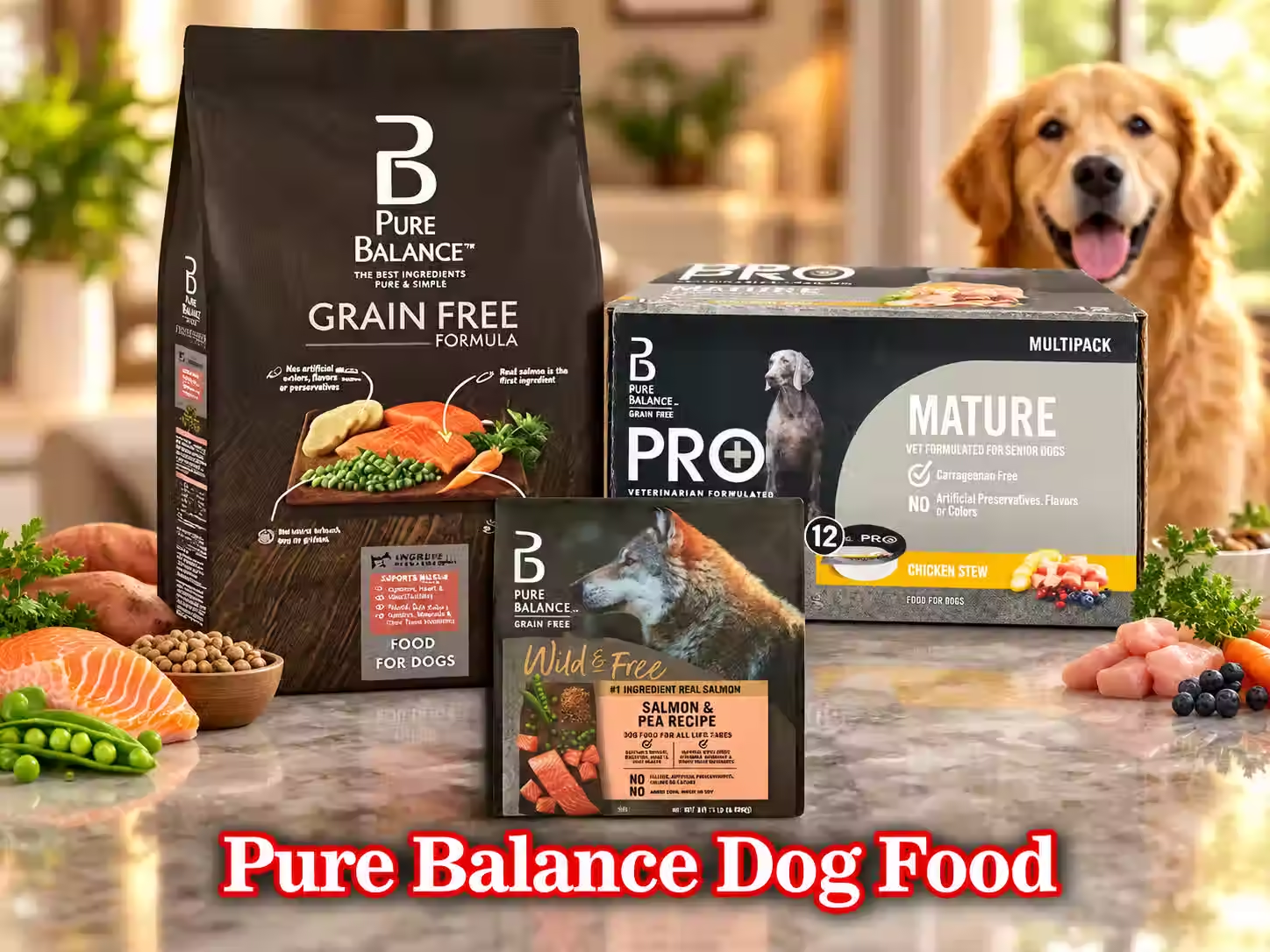
Is Pure Balance a Good Dog Food? Value, Safety & Facts

Is Pure Balance a Good Dog Food? Pure Balance can be a good dog food for owners who need a budget-friendly, complete diet. Its Chicken & Brown Rice recipe has chicken as the first ingredient and lists 27% crude protein, 15% fat, and 324 calories per cup. But the protein figure needs context. Dried peas and pea protein also appear near the top of the ingredient list. The brand offers grain-free and special-care recipes too, so one verdict does not fit every bag.
The best way to judge Pure Balance is to check the exact recipe, life-stage claim, calorie level, and cost per 1,000 calories. This review breaks down those points, compares three other brands, and checks recall records and real buyer feedback. It also explains where a low bag price can help—and where a recipe may not suit a dog with special needs.

Key Takeaways
- Good value: The 30 lb Chicken & Brown Rice bag is listed at $31.47 on rollback, or $34.97 at its regular price.
- Solid basic label: Chicken and chicken meal lead the ingredient list.
- Protein needs context: Dried peas and pea protein also add plant-based protein.
- Recipe choice matters: Grain-free, small-breed, senior, and weight-care recipes have different calorie and nutrient profiles.
- Check life stage: Read the full AAFCO statement on the bag, especially for puppies and large breeds.
- Recall check: No verified Pure Balance recall was found in the records checked for this review.
Quick Verdict: Pure Balance Chicken & Brown Rice is a sensible budget pick for many healthy adult dogs. Its main strengths are price, named animal protein, and a complete-diet claim. Its main limits are the use of pea protein high in the list and limited public detail on the plants and nutrition team behind each recipe.
| Quick check | Finding |
|---|---|
| Best for | Healthy adult dogs on a budget |
| Main ingredients | Chicken, chicken meal, dried peas, brown rice, pea protein |
| Key label figures | 27% protein, 15% fat, 5% max fiber, 10% max moisture |
| Calorie level | 3,567 kcal/kg; 324 kcal/cup |
| Main caution | Check the exact life-stage statement and recipe before buying |

Is Pure Balance a Good Dog Food?
Yes, the Chicken & Brown Rice recipe can suit many healthy adult dogs, but it is not the best fit for every dog. Its value is strong. Its ingredient mix and limited public manufacturing details call for a closer look. AAFCO nutrient profiles help judge whether a recipe meets basic needs. The label must state the life stage it supports; AAFCO does not approve, test, or certify pet foods.
Choose it for: a healthy adult dog that eats chicken, handles dry kibble, and needs an affordable complete diet.
Think twice for: a dog with a diagnosed food allergy, a puppy needing verified large-breed growth nutrition, or a dog on a prescription diet.
Pros and Cons of Pure Balance
The main win is value. The main trade-off is that the crude protein figure comes from both animal and plant ingredients.
| Type | Feature | Observed Real-World Outcome |
|---|---|---|
| Pro | Chicken and chicken meal lead the list | The recipe starts with two named chicken ingredients. |
| Pro | Label gives calories per cup and kg | Owners can set portions with a clear energy figure. |
| Pro | Low bag price | A 30 lb bag costs about $31–$35 at the listed US price. |
| Con | Peas and pea protein rank high | Plant ingredients add to the 27% crude protein figure. |
| Con | Shared production facility | Walmart notes that trace amounts of other ingredients may be present. |
Pure Balance Technical & Performance Analysis: What Do the Facts Reveal?
The standard Chicken & Brown Rice label shows a moderate-protein, moderate-fat dry food with 324 kcal per cup. The first five ingredients are chicken, chicken meal, dried peas, brown rice, and pea protein.
Official Label Breakdown
| Label item | Chicken & Brown Rice |
|---|---|
| Crude protein | 27% min |
| Crude fat | 15% min |
| Crude fiber | 5% max |
| Moisture | 10% max |
| Calories | 3,567 kcal/kg |
| Calories per cup | 324 kcal |
| Ash | Not stated on the label |
These are guaranteed limits, not a full lab report of the food in each bowl. Protein and fat are minimums. Fiber and moisture are maximums.
Dry Matter Basis and Calorie Math
Dry matter basis (DMB) removes water from the comparison. With 10% maximum moisture, the dry matter estimate is 90%.
- Protein: 27 ÷ 90 × 100 = 30.0% DMB
- Fat: 15 ÷ 90 × 100 = 16.7% DMB
- Fiber: 5 ÷ 90 × 100 = 5.6% DMB
The label does not give ash. For a rough carbohydrate estimate only, assume 6% ash:
NFE = 100 − 27 − 15 − 10 − 5 − 6 = 37% as-fed.
Using modified Atwater factors, the estimated energy is 27 × 3.5 = 94.5 kcal from protein, 15 × 8.5 = 127.5 kcal from fat, and 37 × 3.5 = 129.5 kcal from carbs. That gives an estimated split of 27% protein, 36% fat, and 37% carbs by energy. It is a rough calculation: the ash figure is assumed, and guaranteed limits are not typical nutrient values.
Three Pure Balance Recipes Compared
| Recipe | Protein / Fat / Fiber | Calories per cup | Estimated DMB: Protein / Fat / Fiber |
|---|---|---|---|
| Chicken & Brown Rice | 27 / 15 / 5% | 324 | 30.0 / 16.7 / 5.6% |
| Grain-Free Chicken & Pea | 27 / 16 / 5% | 385 | 30.0 / 17.8 / 5.6% |
| Pro+ Small Breed Chicken & Pea | 26 / 15 / 5% | 430 | 28.9 / 16.7 / 5.6% |
All three use 10% maximum moisture in these calculations. The grain-free recipe has more calories per cup than the standard recipe. The small-breed recipe is even more calorie-dense, so a small serving can still pack a lot of energy. Its label excludes growth of large-breed dogs.
What the Ingredient Order Tells You
Chicken gives the recipe a named animal protein. Chicken meal adds a more concentrated protein source because much of its water has already been removed. Dried peas and pea protein also rank high. They can lift the crude protein figure, so 27% protein does not mean all protein comes from meat.
Brown rice adds starch and energy. Beet pulp and flaxseed add fiber. Poultry fat provides energy and fatty acids. The label lists these ingredients, but it does not state the digestibility of the finished food. A high protein number alone cannot prove better protein quality.
Is Pure Balance Suitable for Puppies, Seniors, and Dogs With Special Needs?
Some recipes may fit different life stages, but the exact adequacy statement matters more than the name on the front of the bag. Check the full statement on the back before you feed a puppy or a large-breed dog.
Puppies need a food that meets growth needs. For a dog expected to weigh 70 lb or more as an adult, the AAFCO statement must cover growth of large-breed dogs. Check the calcium, phosphorus, and DHA figures too. Do not assume that a recipe marked “puppy” meets every large-breed growth need.
Pure Balance Pro+ Senior Salmon & Brown Rice lists 24% minimum protein and 12% minimum fat. It is an adult-maintenance food. AAFCO has no separate senior nutrient profile, so the word “senior” is not a separate nutritional standard. For older dogs, track body weight and muscle, not age alone.
The Weight Management Chicken & Oatmeal recipe lists 24.5% protein, 7% fat, and 10% fiber. Its lower fat level may help with portion planning, but calorie content is the key number to get before setting a daily serving. Use body condition scoring: you should be able to feel the ribs without pressing hard, and see a waist from above.
Food Allergies Need a Vet-Led Trial
Itching, sore ears, vomiting, and loose stools can have many causes. A shop-bought limited-ingredient food cannot confirm a food allergy. The Merck Veterinary Manual describes an elimination diet followed by a controlled food challenge as the reliable test. A vet may use a hydrolyzed or novel-protein diet for the trial.
Grain-Free Recipes and the FDA DCM Review
Grain-free does not mean safer or better by default. Pure Balance grain-free recipes use ingredients such as peas and potatoes high on the list, so the FDA’s DCM review is relevant to the discussion.
In 2019, the FDA looked into reports of dilated cardiomyopathy (DCM) in dogs eating some diets with high levels of peas, lentils, other pulses, or potatoes. The reports did not prove that these foods caused DCM. The FDA has also said that cases involved both grain-free and grain-inclusive diets. Pure Balance was not named in the FDA case update as a brand with ten or more reports. That does not prove that any recipe is risk-free.
For most dogs, brown rice and other grains can be useful sources of energy. There is no need to avoid grains unless a vet gives a clear reason. For a grain-free choice, discuss the recipe with your vet first.
Who Makes Pure Balance, and What Is Its Recall History?
Pure Balance is a Walmart private-label brand. Walmart launched it in 2012, but its public brand pages do not name every plant or the team that formulates each recipe. So the brand owner is clear, while the full manufacturing picture is not. (Walmart)(Walmart brand page)
WSAVA advises pet owners to ask who makes a food, who sets its nutrition, and how the maker checks quality. Those are fair questions to ask Walmart. “Vet-formulated” on a product page does not tell you the name or training of the person who made the recipe.
Recall History
I found no verified Pure Balance recall notice in the recall records checked for this review. That is not a promise that every bag is free from risk. Check the lot code and best-by date if you have a safety concern. The FDA keeps recall and safety notices on its official sites. (FDA recall archive)(FDA safety alerts)
| Period | Product scope | Issue or root cause | Kibble or treats? | Record found |
|---|---|---|---|---|
| 2012–Nov. 8, 2026 | Pure Balance brand | No verified brand recall found | No affected product confirmed | No matching notice found in the records checked |
For the latest brand range, use Walmart’s official Pure Balance page. For safe storage, the FDA says to keep dry food in its original bag, store it in a cool, dry place, and keep the lot code. (FDA pet food storage guide)
How to Switch to Pure Balance and Work Out the Cost
A slow food switch can help reduce stomach upset, and the cost per calorie gives a fairer price check than the bag price alone.
A 7–10 Day Food Switch
Use this plan when moving from one dry food to another:
| Days | Old food | Pure Balance |
|---|---|---|
| 1–2 | 75% | 25% |
| 3–4 | 50% | 50% |
| 5–6 | 25% | 75% |
| 7–10 | 0% | 100% |
Keep the daily calorie target steady as you switch. If your dog has loose stools or vomits, pause the change and ask your vet what to do next.
What Does Pure Balance Cost Per Day?
A 30 lb bag is listed at $31.47 on rollback and $34.97 at the regular price. At 3,567 kcal/kg, that bag holds about 48,539 kcal. (Walmart product listing)(label data)
For a fair comparison, I used a sample daily target of 1,076 kcal. This is a math example for a 45 lb adult dog, not a feeding rule for every dog.
- Cost per 1,000 kcal: $0.65–$0.72
- Daily food cost: $0.70–$0.78
- 30-day food cost: $20.93–$23.26
- Daily food amount: about 3.32 cups
- One 30 lb bag: about 45 days at that calorie target
A low bag price is not the whole cost. Delivery fees can cut into the savings. Poor food acceptance can lead to waste. A sealed storage bin also adds an upfront cost, though it can help keep the bag dry and tidy.
Pure Balance also sells wet food. Wet food adds water to a dog’s diet, but opened cans need cold storage. Fresh-frozen meals are a separate food type; do not compare their prices by bag weight alone. Compare the daily calories and feeding cost.
Pure Balance vs. Other Dog Food Brands
Pure Balance costs less per 1,000 calories than these three comparison foods at the prices checked. The table uses the same 1,076 kcal daily target for each food. Prices are US retail prices and can change.
| Comparison | Pure Balance Chicken & Brown Rice | WholeHearted Chicken & Rice | Jinx Chicken, Brown Rice & Sweet Potato | Purina ONE Chicken & Rice |
|---|---|---|---|---|
| Bag price/size | $31.47–$34.97 / 30 lb | $46.99 / 30 lb | $42.54 / 23.5 lb | $48.98 / 31.1 lb |
| Calories per kg | 3,567 | 3,527 | 3,604 | 4,004 |
| Calories per cup | 324 | 330 | 380 | 383 |
| DMB protein | 30.0% | 25.6% | 27.8% | 29.5% |
| DMB fat | 16.7% | 15.6% | 15.6% | 18.2% |
| Cost per cup | $0.21–$0.23 | $0.32 | $0.42 | $0.33 |
| Cost per 1,000 kcal | $0.65–$0.72 | $0.98 | $1.11 | $0.87 |
| Daily cost | $0.70–$0.78 | $1.05 | $1.19 | $0.94 |
| 30-day cost | $20.93–$23.26 | $31.60 | $35.74 | $27.96 |
| Life-stage claim | All life stages on bag front | All life stages | All life stages | Adult maintenance |
Sources: Pure Balance label and price data; WholeHearted product listing and label figures; Jinx label and Walmart price; Purina’s current nutrition page and retailer price. DMB uses each food’s maximum moisture figure. Price math uses bag calories and listed prices. (Pure Balance)(WholeHearted)(Jinx)(Purina ONE)
WholeHearted costs more but has a lower protein minimum. Read our WholeHearted dog food review for a closer look at its range. Jinx has a higher calorie count per cup, so a dog may need fewer cups each day; see our Jinx dog food review.
For a more premium food, compare the full recipe and price with our Stella & Chewy’s dog food review. A higher price does not prove a better match for your dog. Check the life-stage statement, calories, and animal protein sources first.
What Do Real Pure Balance Buyers Say?
Walmart buyer reviews show both strong food acceptance and some reports of stomach upset. The Chicken & Brown Rice listing had a 4.7 out of 5 rating from about 16,800 ratings when checked. Reviews are personal reports, not controlled feeding tests. (Walmart customer reviews)
One verified buyer praised the food and said, “their coats look great.” Another wrote that it was “very good for the price.” A negative verified review said the dog was “battling vomiting and diarrhea for the past three days” after trying the food. These reports show why one dog’s response cannot predict another dog’s result.
Look for patterns over time. Note appetite, stool, skin, coat, and weight. Do not assume one good or bad review proves that a whole recipe line will have the same effect.
Label Claims: What Does the Bag Really Tell You?
The main label claims are mostly easy to check, but a claim is not the same as proof of a health outcome.
| Package claim | What the label supports | Verdict |
|---|---|---|
| Chicken is the first ingredient | Chicken leads the Chicken & Brown Rice ingredient list | Verified |
| No added corn, wheat, or soy | Walmart lists these as not added, but warns that trace amounts may occur at the facility | Partly supported |
| No artificial colors or flavors | Walmart lists both as absent from this recipe | Verified |
| Complete nutrition | The life-stage claim must match the full statement on the exact bag | Check the bag |
For a second view of ingredient types and recipe styles, see our Stella & Chewy’s dog food reviews. The key is to compare the full label, not just a front-of-pack claim.
Frequently Asked Questions
Is Pure Balance a good dog food for adult dogs?
Yes, the Chicken & Brown Rice recipe can suit many healthy adult dogs. Check the calorie amount and life-stage statement, then set a portion that helps your dog keep a steady, healthy weight.
Is Pure Balance made by Walmart?
Pure Balance is a Walmart private-label brand. Walmart launched it in 2012, but public brand pages do not name every plant that makes each recipe.
Does Pure Balance use real meat?
Yes. Chicken is the first ingredient in the Chicken & Brown Rice recipe, followed by chicken meal. Dried peas and pea protein also add plant protein.
Is Pure Balance grain-free?
Some Pure Balance recipes are grain-free, while others use grains such as brown rice or oatmeal. Check the recipe name and full ingredient list before buying.
Is Pure Balance safe for puppies?
Some recipes carry all-life-stage claims, but check the full AAFCO statement on the bag. Large-breed puppies need a food whose statement covers growth of large-breed dogs.
Can Pure Balance help a dog lose weight?
The Pro+ Weight Management recipe has 7% minimum fat and 10% maximum fiber. Ask for its calorie figure and use a vet-approved daily target before setting portions.
Has Pure Balance ever been recalled?
No verified Pure Balance recall was found in the records checked for this review. Check the FDA recall pages for new notices and keep the bag’s lot code.
Is Pure Balance good for dogs with food allergies?
It is not a way to diagnose an allergy. A vet-led elimination diet and food challenge are the reliable way to test for a food allergy.
Practical Buying Checklist and Recipe Guide
Check five things before you buy: the life-stage statement, calories, guaranteed analysis, full ingredient list, and cost per 1,000 kcal.
| Dog or household need | Recipe to check | Key point |
|---|---|---|
| Healthy adult dog | Chicken & Brown Rice | 324 kcal per cup; chicken leads the list |
| Grain-free diet advised by vet | Grain-Free Chicken & Pea | Check the pea and potato content |
| Small adult dog | Pro+ Small Breed Chicken & Pea | 430 kcal per cup; measure portions with care |
| Senior dog | Pro+ Senior Salmon & Brown Rice | Check calories and body weight over time |
| Weight control | Pro+ Weight Management Chicken & Oatmeal | Get the calorie figure before setting a portion |
| Food allergy concern | Vet-selected trial diet | Do not use a retail food to diagnose an allergy |
After purchase, keep the bag and note its lot code and best-by date. Track your dog’s weight, appetite, stool, and body shape over the first 30 days. Ask your vet to review any lasting changes in digestion, skin, or weight.
Consultation
Pure Balance is worth a look if you need an affordable dry food for a healthy adult dog that does well on chicken. Chicken & Brown Rice gives you a named meat ingredient, a clear calorie count, and a low cost per 1,000 kcal. The high placement of peas and pea protein means its crude protein figure is not all meat protein. Its value is strongest when the recipe fits your dog’s needs, and the food is well tolerated.
Choose another food if your dog needs a prescription diet, a vet-run allergy trial, or a formula with confirmed large-breed puppy growth wording. Ask the maker about any missing calorie or nutrient values before you set a daily portion. A good food is not just the cheapest bag; it is one that meets your dog’s needs, keeps body condition on track, and fits your budget over time.

Taslima Akter Sumaiya is a passionate pet mom and the founder of PetFoodHubing.com, dedicated to helping dog and cat parents make informed nutrition and food choices. With a Doctor of Veterinary Medicine (DVM) background and education from the University of California, Davis – School of Veterinary Medicine, along with professional experience connected to the United States Department of Agriculture (USDA), she brings a science-informed perspective to pet food research and reviews. Her work is further informed by authoritative veterinary and animal-health research, including insights from USDA-ARS experts such as Dr. Jitender P. Dubey. Through PetFoodHubing, she aims to make pet nutrition simpler, clearer, and more trustworthy for everyday pet parents. Visit now to get more information on How we test and Sources or about us…