
N&D Dog Food Review: Is Farmina Worth the Higher Price?
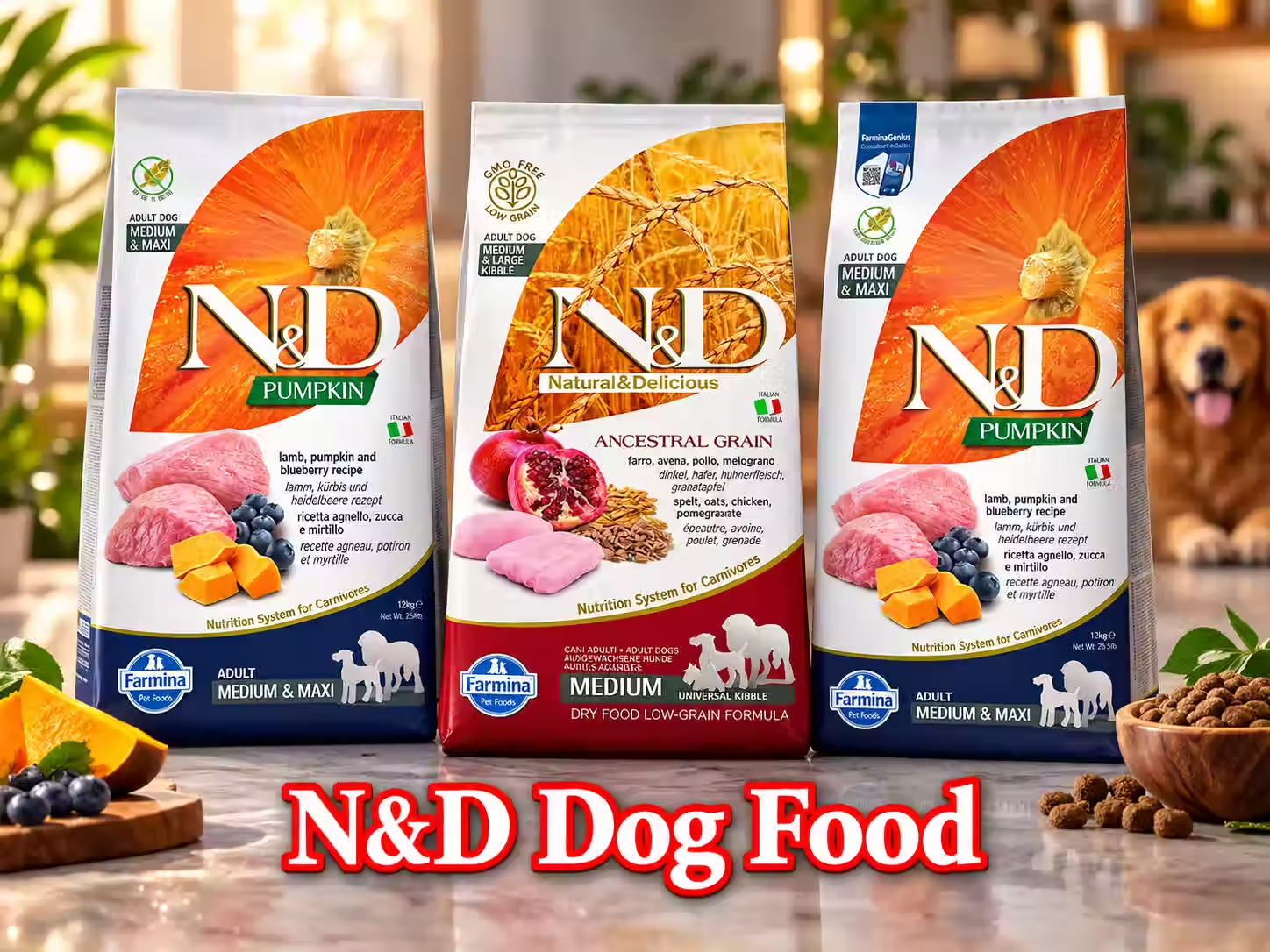
Choosing dog food is not just about meat on the label. You need the right mix of nutrients, a recipe your dog can eat safely, and a price you can afford each month. In this N&D Dog Food Review, we’ll look at Farmina’s N&D range, its ingredients, its nutrition data, and the main pros and cons.
This review draws on current U.S. product labels, published nutrition data, research, and public safety records. It is not a hands-on feeding trial. I won’t invent a dog, claim a food improved its coat, or report test results that never happened. Instead, you’ll get facts you can check and practical ways to judge the food for your own dog.

Key Takeaways
- Best for: Owners seeking a premium food with named meat sources and several recipe choices.
- Main drawback: The price can be high, and the food may not suit every dog’s diet or budget.
- Protein: Some N&D dry recipes have high protein and fat levels.
- Grain choice: The range includes both grain-free and grain-inclusive options.
- Safety: Check the exact recipe and current notices before you buy.
- My verdict: N&D is worth considering, but a higher price does not guarantee better results for every dog.
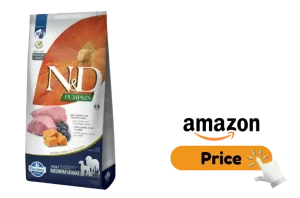
Is N&D Dog Food Good? (N&D Dog Food Review)
Yes, N&D can be a good choice for some dogs. Its recipes offer clear ingredient lists and detailed nutrition data. Still, the best choice depends on your dog’s age, health, energy needs, and food tolerance.
- Who should buy this: Owners of healthy adult dogs who want a premium food and can match a recipe to their dog’s needs.
- Who should skip this: Owners who need a vet-prescribed diet, have a tight food budget, or need to avoid ingredients found in the chosen recipe.
Farmina makes several N&D ranges. They do not all use the same ingredients or serve the same needs. That matters more than the name on the front of the bag.
For example, the U.S. Chicken & Pomegranate Prime dry food for adult medium and large dogs lists 34% minimum crude protein and 18% minimum crude fat. The matching Ancestral Grain recipe lists 30% protein and 18% fat. Both are rich foods, but their ingredient mix differs.
What this N&D Dog Food Review can tell you
The label can tell us what a recipe contains, its stated nutrient levels, and its calorie content. It cannot tell us how every dog will respond.
A food may suit one dog yet cause loose stools or itching in another. That is why I judge N&D by its formula, not by claims that it works for all dogs.
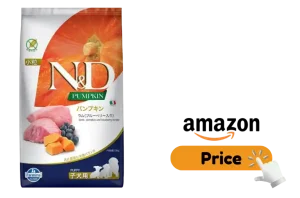
Which N&D Formula Fits Your Dog?
N&D is a product range, not one single recipe. Start with the type of food, then check the exact ingredients and life-stage claim.
| N&D range | Main feature |
|---|---|
| Prime | Grain-free recipes with animal proteins and other selected ingredients |
| Ancestral Grain | Recipes that use grains such as spelt and oats |
| Pumpkin | Recipes built around pumpkin, with other ingredients that vary by product |
| Other N&D recipes | Protein choices and nutrition details vary by formula and market |
The range name is only a starting point. Read the full label before you buy. Recipe names and ingredient lists may differ by country, so do not assume that a bag sold in one market matches a bag sold elsewhere.
Prime or Ancestral Grain?
Prime may suit a dog whose owner wants a grain-free recipe. Ancestral Grain may suit an owner who prefers a grain-inclusive food. Neither choice is automatically better for every dog.
The key question is whether the full recipe meets your dog’s needs. A grain-free label alone does not make a food more nutritious.
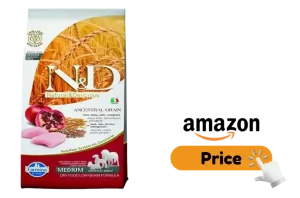
Pros and Cons of Farmina N&D
N&D has real strengths, but it has trade-offs. Its ingredient detail is useful, while its price and rich nutrient profile may make it a poor fit for some homes.
| Type | Feature | Review assessment |
|---|---|---|
| Pro | Named animal proteins | The listed protein sources are easy to identify in many recipes. |
| Pro | More than one range | Owners can compare grain-free and grain-inclusive choices. |
| Pro | Detailed nutrient data | Some official product pages list calories and nutrient levels. |
| Pro | Added nutrients | Some recipes list chelated minerals and other added nutrients. |
| Pro | Wet and dry choices | Certain N&D ranges offer more than one food format. |
| Con | Premium price | The cost may be hard to sustain over months or years. |
| Con | Multiple protein sources | Some recipes contain several animal proteins, which can complicate food trials. |
| Con | Rich nutrient profile | High fat and calorie levels may not suit every dog’s needs. |
| Con | Recipe differences | You must check each formula rather than judge the whole brand at once. |
| Con | Not a medical diet by default | A standard N&D recipe should not replace a diet prescribed by a vet. |
The main lesson is simple: do not choose N&D just because it looks premium. Choose it when a specific recipe fits your dog better than the other foods you can buy.
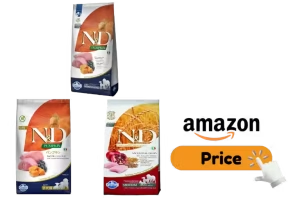
What Do N&D Ingredients and Nutrition Numbers Tell Us?
N&D uses named protein sources, and some dry recipes have high protein and fat levels. The full ingredient list and the calorie figure tell you more than the front label alone.
Take the U.S. Chicken & Pomegranate recipes as an example. The Prime formula lists chicken, dehydrated chicken, sweet potatoes, chicken fat, eggs, and herring. The Ancestral Grain formula lists chicken, dehydrated chicken, spelt, oats, and other ingredients.
That gives you a clear starting point. But the first few ingredients do not tell the whole story. The food must also supply the right balance of amino acids, fats, vitamins, and minerals.
N&D dog food nutrition at a glance
The table below uses figures from the maker’s U.S. product pages. These are label values, not results from an independent lab test of a bag bought for this review.
| Nutrition detail | Prime Chicken & Pomegranate | Ancestral Grain Chicken & Pomegranate |
|---|---|---|
| Crude protein, minimum | 34% | 30% |
| Crude fat, minimum | 18% | 18% |
| Crude fiber, maximum | 2.6% | 2.9% |
| Moisture, maximum | 9% | 9% |
| Listed calories | 432 kcal per cup | Check the exact current label |
Sources: Farmina’s U.S. product pages for Prime and Ancestral Grain.
These figures are not a scorecard. More protein does not always mean better food. A less active dog may need fewer calories than a working dog of the same size.
What to check on the label
A quick label check can stop you from buying the wrong recipe.
| Label detail | Why it matters |
|---|---|
| Ingredient list | Shows the ingredients in descending order by weight. |
| Guaranteed Analysis | Gives set minimum or maximum nutrient levels, not the exact amount in every batch. |
| Nutritional adequacy statement | Tells you which life stage the food is made to support. |
| Calorie statement | Helps you match daily portions to your dog’s energy needs. |
| Manufacturer details | Gives you a contact for product questions or concerns. |
The Association of American Feed Control Officials (AAFCO) explains these label details and how to read them. AAFCO does not approve individual pet foods. Look for the nutritional adequacy statement on the exact product you plan to buy.
Is Grain-Free N&D Safe for Dogs?
A grain-free diet is not automatically safer or better than a grain-inclusive diet. Choose it for a clear reason, not because the label sounds more natural.
Some N&D Prime recipes use sweet potatoes and other non-grain ingredients. Others in the range use grains. The exact mix matters, so read the recipe rather than relying on the brand name.
The U.S. Food and Drug Administration (FDA) has investigated reports of dilated cardiomyopathy, or DCM, in dogs eating certain diets. Many reported diets were labeled grain-free and used peas, lentils, other legumes, or potatoes among their main ingredients. The FDA has not established that one specific ingredient or brand causes all such cases. It also describes DCM as a complex issue with several possible factors.
This does not mean every grain-free food is harmful. It means a grain-free label alone is a weak reason to choose a diet.
If you are unsure which type suits your dog, ask your vet to review the full formula and your dog’s health history before making it the long-term diet.
Is N&D Dog Food Worth the Price?
N&D may be worth the cost if its recipe suits your dog and fits your budget. It is less compelling when a simpler complete food meets the same needs for less money.
At the time of research, Farmina’s U.S. product page listed a 5.5 lb bag of Prime Chicken & Pomegranate at $38.99, or about $7.09 per pound. That is one product listing, not a fixed price for every N&D recipe or market.
A fair price comparison should use the daily cost, not just the bag price. Food with more calories per cup may need a smaller portion. Still, each dog’s needs differ, so do not cut the serving just to make a premium bag last longer.
A practical example
Picture Cooper, a hypothetical 4-year-old Golden Retriever who eats an adult maintenance diet. The owner should compare the calorie needs of this dog with the food’s feeding guide, then check body weight and shape over time. Cooper is an example, not a test subject, and no health result is being claimed.
Now picture a dog that needs to lose weight. A rich food may make portion control harder. The lower-cost option may be the better choice if it meets the dog’s nutrition needs and makes daily calories easier to manage.
How Should You Switch Your Dog to N&D?
A gradual change is often easier on a dog’s gut than a sudden swap. Use a slow mix of the old food and the new one, and adjust the pace if your dog has a sensitive stomach.
Here is a common seven-to-ten-day plan. It is a starting point, not a fixed rule for every dog.
| Days | Mix to try |
|---|---|
| 1–2 | 25% new food and 75% old food |
| 3–4 | 50% new food and 50% old food |
| 5–6 | 75% new food and 25% old food |
| 7–10 | Move to 100% new food if your dog is doing well |
Keep an eye on appetite, stool, and comfort during the change. Do not rush the next step if your dog has a bad response.
| What you notice | What to do |
|---|---|
| Mild, short-lived stool changes | Hold the current mix and watch closely. |
| Repeated vomiting or ongoing diarrhea | Stop the change and contact your vet. |
| Blood in stool, marked weakness, or facial swelling | Seek prompt veterinary help. |
For a dog on a prescribed diet, speak with the vet before changing foods. That advice matters more than a general feeding schedule.
Has N&D Dog Food Had Any Recalls?
A recall check should focus on the exact product, date, and lot, not just the brand name. Public records show a U.S. enforcement entry for one N&D recipe in March 2026.
A pet food watchdog reported that an FDA enforcement database entry dated March 25, 2026, concerned N&D Tropical Selection Salmon, Spelt, Oats and Tropical Fruits Recipe Dog Food. The reported issue was a mismatch between the salmon name on the front label and lamb listed on the ingredient panel. The report was described as a Class III recall. The available account did not confirm whether the error was limited to the packaging or involved the food itself.
| Detail | Reported information | What it means |
|---|---|---|
| Date | March 25, 2026 | A U.S. enforcement record was reported. |
| Product | N&D Tropical Selection Salmon, Spelt, Oats and Tropical Fruits | The report named one specific recipe. |
| Issue | Salmon on the front, lamb on the ingredient panel | Check the product and lot against official records. |
This entry does not show that every N&D recipe was affected. Before buying, check the maker’s notices and the FDA’s recall records. If you have the named product, confirm its lot details with the maker and follow the official advice for that item.
How Does N&D Compare With Other Dog Food Brands?
The best comparison is one recipe against another, using the same needs and budget. A brand name alone cannot tell you which food is the right fit.
N&D sits in the premium part of the market. If you want to compare another premium option, read our review of Acana. Compare the exact recipes, not just their marketing claims.
For a wider look at foods in a different price range, see our Purina Pro Plan comparison. You can also review NutriSource and Blue Buffalo when weighing other options.
When you compare them, focus on four things: the life stage claim, calories, the main protein sources, and the daily cost. This gives you a more useful answer than choosing the bag with the most appealing front label.
Final Thoughts on N&D Dog Food Review
My verdict is that Farmina N&D is worth a close look, but it is not an automatic best buy. Its product range offers clear ingredient lists and some detailed nutrition data. The cost and recipe differences mean you should still choose with care.
Read the exact label, match the food to your dog’s needs, and weigh the daily cost. For another reliable starting point, see AAFCO’s guide to selecting the right pet food. It explains why the right food depends on life stage, health, and the product’s nutritional adequacy statement.
FAQs for N&D Dog Food Review
Does N&D dog food meet AAFCO standards?
Some U.S. recipes say they meet AAFCO Dog Food Nutrient Profiles for adult maintenance. Check the exact bag, since a claim on one recipe does not cover the whole range.
Is N&D suitable for puppies?
Only choose a recipe whose label says it is complete and balanced for growth or all life stages. An adult-maintenance formula alone is not the right pick for a puppy.
Is N&D dog food good for dogs with food allergies?
Not by default. Some recipes use more than one animal protein, so read the full ingredient list and ask your vet about a diet trial if you suspect a true food allergy.
Does Farmina N&D offer wet dog food?
Yes, Farmina sells wet and dry options in some N&D ranges. Compare calories per can or cup and choose the format that best fits your dog’s needs.
Is N&D Dog Food Review enough to decide whether it is worth the price?
Use this N&D Dog Food Review as a starting point, then compare daily cost, the exact formula, and your dog’s needs. A costly label alone does not prove a food is better.